Anthropological Responses to Health Emergencies (ARHE) is a Special Interest Group of the Society for Medical Anthropology. The purpose of the group is to network among members to be able to rapidly respond to developing public health issues and emergencies.
Welcome to the new Co-Chair
We are delighted to welcome Vaia (Yioula) Sigounas as the new co-chair of the Anthropological Responses to Health Emergencies (ARHE) SIG. Yioula brings deep experience and insight into the social, cultural, and ethical dimensions of health emergencies, and we are excited to have her leadership and perspective join the group. Yioula will be joining Lauren Carruth as co-chairs of ARHE as of February 2026. Please read a bit more about Yioula’s work below.

Vaia (Yioula) Sigounas is a sociocultural medical anthropologist working at the intersection of local and global health inequities, humanitarian aid, and medical technology. Her work focuses on sub-Saharan Africa and the United States. She completed her Ph.D. in medical anthropology at the University of North Carolina at Chapel Hill and her postdoctoral fellowship in cardiovascular disease epidemiology at the Gillings School of Global Public Health. Prior to this, she earned an A.B. magna cum laude in literature from Harvard University, an M.D. from UNC-Chapel Hill, and trained as a general surgeon.
Dr. Sigounas’ work has been funded by grants from the National Science Foundation in Anthropology and Science and Technology Studies and a T32 award from the NIH. She has published articles in academic journals, including Medical Anthropology Quarterly and Infection and Immunity, and is currently working on her first book about how medical technologies built in the Global North travel to the Global South and serve as vectors for the ideals, judgments, and goals that their societies of origin have toward persons with disabilities. At CWRU she teaches Introduction to Medical Anthropology, Bodies Technologies Societies, and Humanitarianism and Humanitarian Aid.
2025 ARHE Policy Brief Award Winners
The ARHE Awards Committee is thrilled to announce the 2025 Policy Brief team winners. The Committee was extremely impressed with the quality of submissions and examples of the power of anthropology to inform policy. Please join us in congratulating:
Professional Level:
The winner of the 2025 ARHE Policy Brief Award at the Professional level is the interdisciplinary team led by anthropologists Dr. Jean Hunleth and Dr. Mutale Chileshe (1978-2021) from Washington University School of Medicine in the U.S. and Copperbelt University School of Medicine in Zambia, with Dr. Comfort Asante, Emma Bunkley, Sarah Burack, Lindsey Kaufman, Mary McKee, and Dr. Sam Miti. This important and innovative project was designed to improve care for family caregivers in Zambia, who worked both within and outside clinical spaces during the COVID-19 pandemic and were key to ensuring high quality and personalized medical care for patients. The researchers found that while family caregivers were “the infrastructure holding Zambian hospitals together,” the conditions in which they worked in hospitals were harmful to their health, morale, and ability to effectively care for their loved ones. The report not only demonstrated use of rigorous qualitative methods, but presented sets of findings with actionable recommendations for improvements to facilities and care for caregivers. We were impressed with the already wide dissemination of the report to the Zambian policy administrators and hospital personnel. We found this project and partnership met the needs of the community and clinical facilities in Zambia, but beyond that, these researchers demonstrate how important it is to design health and clinical interventions (in health emergencies, but even more generally) focused on the needs of caregivers – not just patients. We congratulate this incredible team for their hard work, and hope their report may inspire others.
Student Level:
The winner of the 2025 ARHE Policy Brief Award at the Student level is the team of Anuoluwapo Ajibade, a PhD student in medical anthropology at Case Western Reserve University, with his co-authors on the report, Dr. Megan Schmidt-Sane from the Institute of Development Studies, and Dr. Janet McGrath – Professor and Chair of the Department of Anthropology at Case Western Reserve University. This British Academy funded (PI: Dr Santiago Ripoll) anthropological research project in three cities, including Cleveland, Ohio, focused on public health community engagement for pandemic preparedness and lessons learned from the COVID-19 pandemic. Results of the study included a set of recommendations for Cleveland – but really any community – to not just plan for better responses to health emergencies, but to use community engagement and pandemic preparedness to more broadly improve health equity. We congratulate this team for their hard work and applaud the recommendations included in the report.
2025 Policy Brief Award
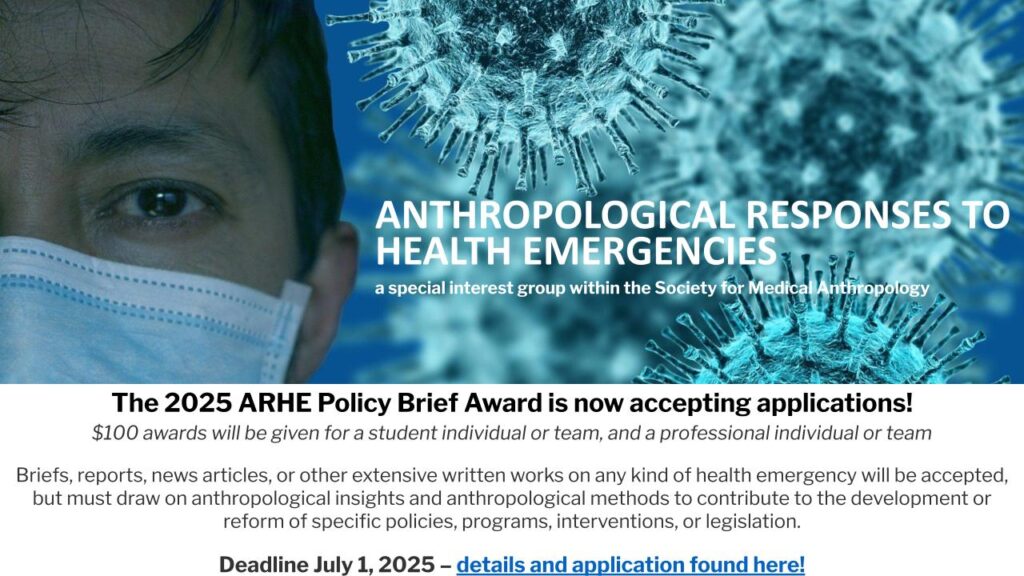
We are excited to announce that the 2025 ARHE Policy Brief Award is now open for submissions. The aim of the award is to encourage and acknowledge the contributions of anthropologists by providing the humanistic side of policy recommendations for responding to health emergencies.
Criteria:
- Teams, not just individuals, may apply, including teams fulfilling professional contracts or consultancies.
- Instead of only accepting policy briefs in their traditional format, we will now accept written works, detailed or annotated PowerPoint presentations, or other works that contribute to the development of new legislation, policies, programs, or interventions using significant anthropological data and anthropological insights. This may include long-form editorials, news articles, or other public-facing publications that include recommendations or ways forward, as long as they draw on anthropological perspectives and methods.
- Submission may be no more than 10,000 words in total
- All health emergencies topics are accepted.
- The work must explicitly discuss and integrate anthropological methods and insights.
- The brief does not necessarily have to report on new data collected, but can also analyze existing data to make recommendations or ways forward.The work must make direct reference to specific policies, practices, programs, and/or interventions, and make explicit recommendations for ways forward from these, in addition to assessing and critiquing. In other words, this award recognizes applied and engaged work, not work that only makes critical or theoretical arguments.
For examples of policy briefs, please see past winners: https://arhe.medanthro.net/2024-arhe-policy-brief-award-winner/
Applications can be submitted at : https://forms.gle/W2ZXAuQM1XftKegr9
2024 ARHE Policy Brief Award Winner
The ARHE Awards Committee is thrilled to announce the 2024 Policy Brief winner. The Committee was extremely impressed with the quality of submissions and examples of the power of anthropology to inform policy. Please join us in congratulating:
Professional winner: Daniel Manson for his policy brief entitled Youth Voices on Treatment in the Shadow of the Overdose Crisis: Key Recommendations and Findings for Care Providers
2024 ARHE Policy Brief Award
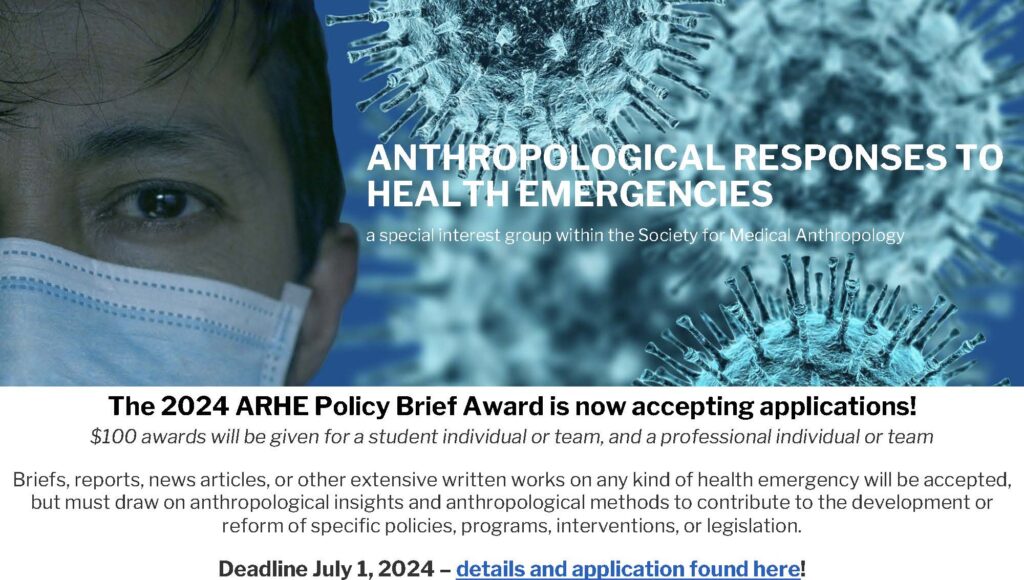
We are excited to announce that the 2023 ARHE Policy Brief Award is now open for submissions. The aim of the award is to encourage and acknowledge the contributions of anthropologists by providing the humanistic side of policy recommendations for responding to health emergencies.
Criteria:
- Teams, not just individuals, may apply, including teams fulfilling professional contracts or consultancies.
- Instead of only accepting policy briefs in their traditional format, we will now accept written works, detailed or annotated PowerPoint presentations, or other works that contribute to the development of new legislation, policies, programs, or interventions using significant anthropological data and anthropological insights. This may include long-form editorials, news articles, or other public-facing publications that include recommendations or ways forward, as long as they draw on anthropological perspectives and methods.
- Submission may be no more than 10,000 words in total
- All health emergencies topics are accepted.
- The work must explicitly discuss and integrate anthropological methods and insights.
- The brief does not necessarily have to report on new data collected, but can also analyze existing data to make recommendations or ways forward.The work must make direct reference to specific policies, practices, programs, and/or interventions, and make explicit recommendations for ways forward from these, in addition to assessing and critiquing. In other words, this award recognizes applied and engaged work, not work that only makes critical or theoretical arguments.
Applications can be submitted at : https://forms.gle/W2ZXAuQM1XftKegr9
2023 ARHE Policy Brief Award Winners
The ARHE Awards Committee is thrilled to announce the 2023 Policy Brief winners. The Committee was extremely impressed with the quality of submissions and examples of the power of anthropology to inform policy. Please join us in congratulating:
Student winner: Taylor J. Arnold for his policy brief entitled Latinx Child Farmworkers in North Carolina: Heat-Related Illness
Professional winner: Magdalena Stawkowski for her policy brief entitled Forgotten Ground Zeros: Local Populations Exposed to Radiation from Former Nuclear Test Sites
2023 ARHE Policy Brief Award
We are excited to announce that the 2023 ARHE Policy Brief Award is now open for submissions. The aim of the award is to encourage and acknowledge the contributions of anthropologists by providing the humanistic side of policy recommendations for responding to health emergencies.
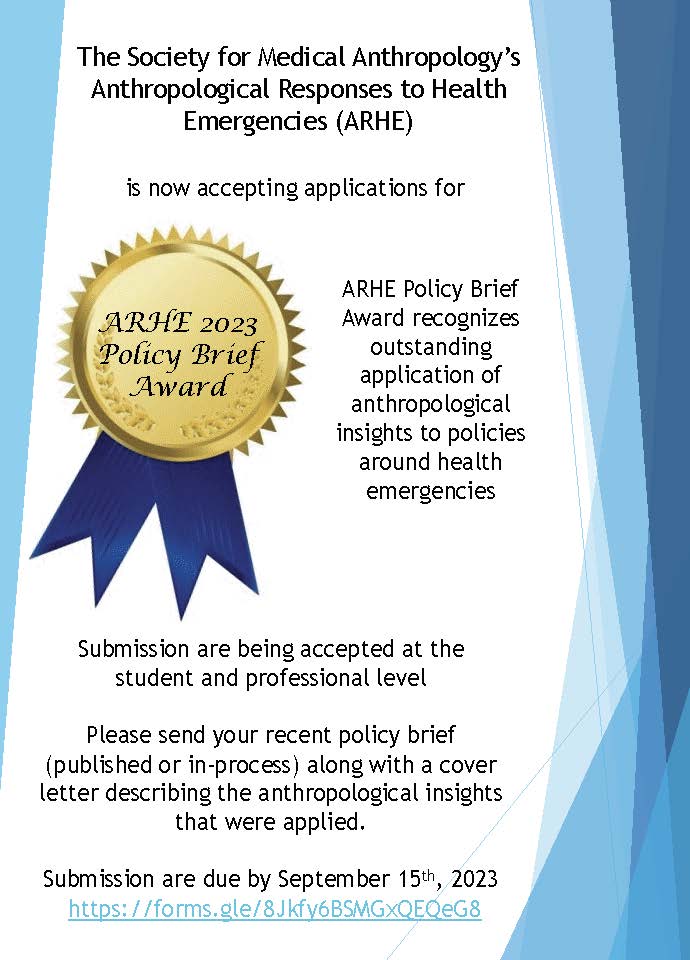
There are two levels for the award (student and professional), both have a $100 award each.
Criteria
- No more than 10 pages
- All health emergencies topics are accepted
- Must integrate anthropological insights necessary for a successful response effort
Submission accepted at https://forms.gle/8Jkfy6BSMGxQEQeG8
All submissions due by September 15, 2023.
2022 ARHE Policy Brief Award Winners
The ARHE Awards Committee is thrilled to announce the 2022 Policy Brief winners. Please join us in congratulating:
Student winner: Alyssa Basmajian for her policy brief entitled Doulas offer compassionate abortion care and counter stigma
Professional winner: CommuniVax for their policy brief entitled Carrying Equity in COVID-19 Vaccination Forward: Guidance Informed by Communities of Color. Visit https://www.communivax.org/our-work for the full report and other resources
Professional winner: Megan Schmidt-Sane for her policy brief entitled COVID-19 vaccines and (dis)trust among minoritized youth in Ealing, London, United Kingdom. Visit https://www.socialscienceinaction.org/search?post_types=resources for the full report and other resource https://www.socialscienceinaction.org/search?post_types=resources
ARHE Policy Brief Award
We are excited to announce the first annual ARHE Policy Brief Award is now open for submissions. The aim of the award is to encourage and acknowledge the contributions of anthropologists by providing the humanistic side of policy recommendations for responding to health emergencies.
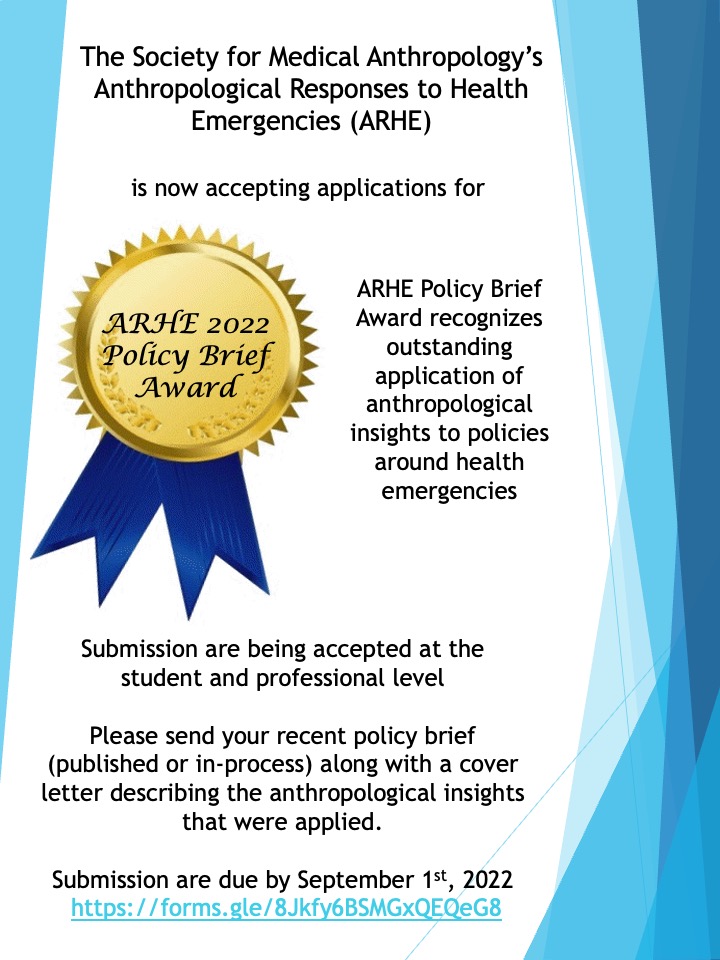
There are two levels for the award (student and professional), both have a $100 award each.
Criteria
- No more than 10 pages
- All health emergencies topics are accepted
- Must integrate anthropological insights necessary for a successful response effort
Submission accepted at https://forms.gle/8Jkfy6BSMGxQEQeG8
All submissions due by September 1, 2022.
COVID-19 Continued Information Resources
Check out the new slide deck from Dr. Mark Nichter reviewing the COVID-19 variants, public health balancing act, and public health citizenship.
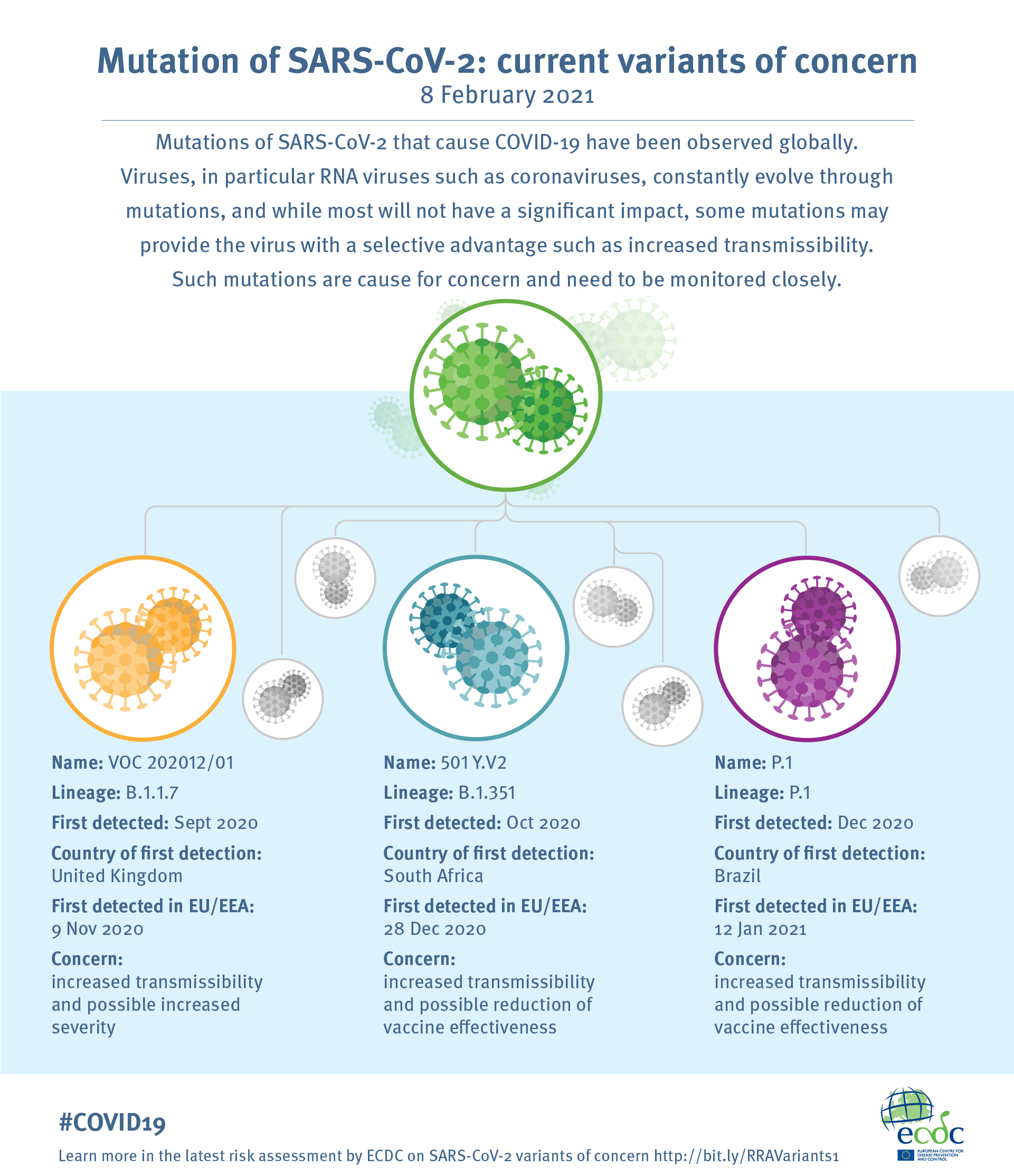
Check out the European Centre for Disease Prevention and Control excellent Info-graph of the variants